Vape Vending Machine Business: Cost, Profit & Legal Guide
April 23, 2026
Gym Vending Machine Business: Costs, Profits, and Setup Guide
June 18, 2026
You walk into a small store, pick what you need, and simply walk out. No cashier, no fumbling for your wallet, no standing behind someone who can’t find their loyalty card. Just grab your stuff and go. That’s exactly the kind of experience an AI vending machine is built around, and honestly, once you’ve tried it, regular checkout lines feel almost offensive.
This isn’t some futuristic concept either. It’s already happening, and businesses are moving toward it faster than most people realize. So let’s break down what these machines actually are, how they pull off that seamless walk-out experience, and why retailers are jumping on board.
What Is an AI Vending Machine?
Think of it as a vending machine that grew up. A traditional vending machine makes you pick from a grid, press D4, and pray the bag of chips doesn’t get stuck. An AI vending machine is nothing like that.
An AI vending machine is a self-service retail system that uses cameras, sensors, and software to identify products and process payments automatically. No buttons, no scanning, no cashier interaction. The machine figures out what left on the shelf, matches it to your payment method, and charges you after you walk out. It’s part of a much bigger shift toward autonomous retail, where the store essentially runs itself.
How AI Vending Machines Work
From the outside, it looks almost too simple. You tap your card or phone to unlock the unit, pull the door open, grab what you want, and leave. That’s it from your side. Behind the door, it’s a different story. The moment you open it, the system starts watching, tracking what’s on the shelves, monitoring what your hands are doing, and logging any changes. The whole thing wraps up in seconds, and you never had to tell it anything.
Technology in AI-Powered Vending Machines
Computer Vision and Product Recognition
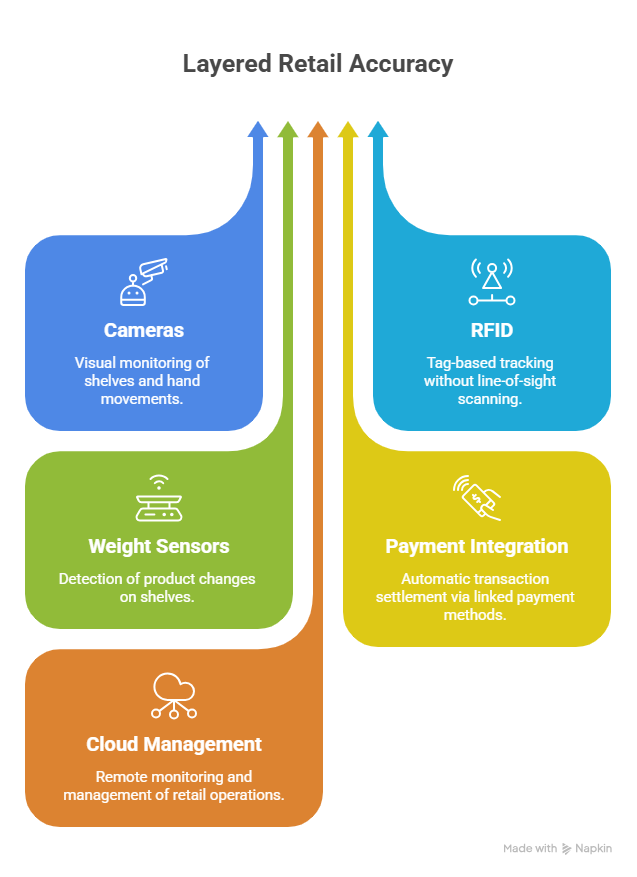
There are cameras mounted inside these machines and they’re doing much more than just recording footage. They’re actively watching the shelves and following hand movements to figure out exactly what got picked up.
The system behind those cameras is trained on huge amounts of product data, so it can tell the difference between, say, a protein bar and a granola bar if the packaging looks similar from a distance. And the more it runs, the sharper it gets. Each interaction teaches it something new, products get repackaged or new items are added.
RFID Technology
Some machines skip cameras for some tasks and lean on RFID instead.
The machine’s readers scan all embedded product tags at once. You don’t need line-of-sight or individual scans, it just knows what’s in there.
Key RFID capabilities
| Capability | What it does | Benefit |
| Item tagging | Assigns a unique ID to each product | Enables quick identification |
| Bulk reading | Detects multiple items at once | Speeds up checkout |
| Real-time updates | Tracks item movement | Improves accuracy |
Smart Weight Sensors
Shelves are equipped with weight sensors that detect even small changes when products are picked or returned. This data helps confirm which items were taken, adding another layer of accuracy to the system.
Weight sensor advantages
| AI Vending Machine Feature | Business Benefit |
| High sensitivity | Detects small or light items |
| Instant response | Updates stock immediately |
| Scalable setup | Works across different machine sizes |
Triple Verification System
Most serious deployments don’t rely on just one of these technologies; they use all three together. Cameras handle the visual side, RFID tracks the tags, and weight sensors confirm the physical changes. If two systems agree and one seems off, the others can correct it.
This layered approach is what makes accuracy reliable enough for real commercial use. Product misidentification is one of the biggest concerns in autonomous retail, combining three independent data sources brings the error rate down to where operators can actually trust the system.
Contactless Payment Systems
You link your payment method when you enter, by tapping a card or scanning your phone. From that point on, the machine knows who you are and what you’re being charged for. When you leave, it settles the transaction automatically. No PIN, no signature, no second step. The whole payment side of things happens quietly in the background.
Cloud-Based Management Platform
Operators manage the machine through a centralised cloud platform. They can monitor sales, track inventory, and receive alerts without being physically present at the location.
Step by Step: What Happens During a Purchase
| Site | Action | System response |
| 1 | The user unlocks the machine | A session begins |
| 2 | Items are selected | Sensors and cameras track activity |
| 3 | The door is closed | Session ends |
| 4 | Data is verified | The system cross-checks inputs |
| 5 | Payment is processed | The receipt is sent digitally |
How to Use an AI Vending Machine
Using one of these machines for the first time feels almost too easy. You tap your card or scan a QR code to unlock the door, grab whatever you need, and close it behind you. That’s genuinely all you have to do.
The system takes care of the rest; it processes your items and sends a receipt straight to your phone or email. Most locations don’t even ask you to download an app, which means pretty much anyone can use it without any setup or learning curve.
What’s the Difference Between AI and Smart Vending Machines?
People mix these two up a lot, and it’s an understandable mistake.
Smart vending machines are an upgrade from the old coin-slot era; they accept card payments, have touchscreens, and look modern. But you still have to press buttons and tell the machine what you want. AI vending machines skip that part entirely. They watch what you take and handle the transaction automatically. It’s a fundamentally different experience, not just a cosmetic upgrade.
AI Vending Machines vs Traditional Vendings
| Feature | AI vending | Traditional vending |
| Checkout process | Automatic and seamless | Manual selection required |
| Speed | Very fast | Slower |
| Product variety | Wider range | Limited options |
| User effort | Minimal | Moderate |
| Data insights | Detailed tracking | Basic reporting |
| Maintenance | Predictive | Reactive |
Ai Vending Machine Experiment
The reason businesses keep piloting these machines comes down to two things: happier customers and lower operating costs. When checkout is frictionless, people don’t rush. They browse a little longer and tend to pick up more than they planned. That naturally pushes the average order value up.
On the operator side, you’re looking at leaner staffing needs and inventory data that actually tells you something useful: not just what sold, but when, how often, and what tends to go together.
Pros and Cons
Pros
- Faster and more convenient shopping experience
- Improved inventory tracking
- Increased average purchase value
- Lower dependency on staff
Cons
- Higher initial investment
- Dependence on stable internet connectivity
- Setup can be complex in the beginning
- Some users may have privacy concerns
Real World Use Cases
These machines slot in best wherever people are busy and don’t want to wait. Offices, hospital corridors, airport terminals, university campuses, hotel lobbies, gyms – anywhere foot traffic is high and time feels short. In those settings, a traditional vending machine or staffed kiosk just can’t keep up with the pace people expect.
How Revenue Increases
Two things drive the revenue bump: behavior and data. On the behavioral side, a frictionless checkout removes hesitation. People don’t think twice about grabbing an extra item when there’s no line and no transaction to fumble through. On the data side, operators can see exactly which products move, at what times, and adjust accordingly. That means less dead stock sitting on shelves and more of what people actually want.
Data and Smart Analytics
Every interaction with the machine generates useful data. This includes purchase timing, product popularity, and user behavior patterns. Businesses can use this data to optimise product selection, pricing strategies, and promotional campaigns.
Personalisation and Experience
Some systems offer personalized recommendations based on user behavior. Digital displays can suggest products or highlight offers, creating a more engaging experience. This helps build repeat usage and stronger customer retention.
Sustainability and Efficiency
Better inventory control leads to less product waste, especially for perishable items. Energy usage can also be optimized through smart cooling systems that adjust based on demand and usage patterns.
Challenges to Consider
Despite the centralized system, there are challenges that businesses need to address. Initial costs can be high, and reliable internet connectivity is essential for smooth operation. Maintaining high accuracy also requires regular updates and system monitoring.
The Future of Cashierless Retail
The trajectory here is pretty clear: more automation, more locations, and smarter systems overall. As IoT integration deepens and predictive analytics get more refined, these machines will start anticipating demand rather than just responding to it. Restocking before shelves run low, adjusting pricing based on patterns, and flagging maintenance needs before anything breaks. Urban areas, transport hubs, and workplaces are the obvious next frontier. But the technology is moving fast enough that the question isn’t really if cashierless retail becomes mainstream; it’s just a matter of how quickly.
FAQs About Ai Vending Machines:
Not all of them, no. Older machines have no reason to; when someone presses a button and a product drops, there’s nothing to visually track. But modern AI vending machines are a different story. They rely on cameras to follow what’s happening inside the unit in real time, so yes, if you’re using one of these, cameras are watching the shelves. It’s how the system knows what you picked up.
It’s never just one thing doing the work. Most systems layer cameras, weight sensors, and sometimes RFID tags on top of each other. The camera catches the visual, the shelf sensor confirms something was removed, and the RFID tag (if the product has one) backs it all up with a unique ID. When two or three signals agree on the same item, the system logs it with confidence. That overlap is exactly why these machines rarely get the charge wrong.
There’s a wide range depending on what you’re getting. A basic unit might run a few thousand dollars, while a fully loaded machine with high-resolution cameras, multiple sensor layers, and real-time cloud integration can push well into the tens of thousands. Size matters too; a compact office unit costs considerably less than something built for a high-traffic airport terminal. It’s one of those cases where you really do get what you pay for.
The short answer is autonomy. A regular machine waits for you to tell it what you want. An AI-powered one figures that out on its own by watching what you interact with, cross-referencing product data, and making a decision, all without any input from you. Over time, it also gets better at what it does. It picks up on patterns, handles new products more smoothly, and improves its accuracy the more it runs. That self-learning piece is really what earns the “AI” label.